Adolescence is a major milestone in the physical and emotional development of our lives. It is regarded as the most turbulent stage in emotional development. The upsurge of sex hormones changes the body and the mind of adolescent remarkably and rapidly. Emotional development in adolescence is driven by a growing sense of independence, experimentation, peers and psycho-sexual growth. Emotional development is closely interrelated to physical development and vice versa.
According to the available literature, 85 per cent of children overcome adolescent changes without any problems while 15 per cent of children exhibit problematic behavior. The problem behavior can vary from mild irritability to extreme aggression. During this phase of development mood swings are very common. Aggression becomes a frequent mode of emotional expression. The growing feeling of independence conflicts with the standards set by parents and society. Adolescents start to visualize the world through the eyes of their peers. It is not easy to sustain the peer pressure. For most adolescents, the behavior of their peers becomes the norm. Children during adolescence are more open for experimentation out of curiosity. This adds to various risky behaviors.
Frequent physical or verbal arguments are not uncommon during adolescence. Adolescents are also vulnerable for relationship issues because of psycho-sexual growth and infatuation related to that. They are also prone to the various antisocial activities and addictions. It is important to know that in many adults with addictions, use of addictive substances begins during adolescence. These growth spurts related behavior and social problems affect the academic growth of the child. It also leads to various medical problems.
Today’s adolescents are also excessively inclined towards the screen use. The digital revolution has changed the life of everyone and adolescents are not exception for it. 60 percent of the world’s population is online at any moment of time. Among various addictions, adolescents are suffering most by screen related addictions or internet addictions. Online gaming addiction, social media addiction and pornographic addiction are few common internet addictions in this age group. It significantly affects the emotional, physical, academic, personal and social growth of adolescents.
Needless to say that almost all adolescents need guidance during this phase of hormonal ups and downs. As parents and medical professionals, we need to be more alert during this phase of our children. Firm but warm type of parenting, good bidirectional communication with adolescents, listening to their concerns, respecting and valuing their suggestions, explaining them about science behind adolescence, explaining them about impending physical and emotional changes are few methods to deal with these youngsters.
Channelizing energy of adolescents in socially acceptable activities is an important tool to manage various emotional problems of the adolescents. Sports, music, dance, painting, craft, etc. are the most commonly used activities to sublimate their emotions and also to keep them engage. Among all these activities, sports have a unique place in the life of adolescence.
Sports have been traditionally seen as a part of physical development. But, it is equally important for emotional health. Our objective should be balanced growth of adolescent, physically and emotionally. Digitization and academic pressure have taken away the sports from the life of many adolescents. They are deprived of the specific benefits of sports. There are various psychological advantages of sports.
Sports channelize our aggressive emotions in an acceptable manner. It has a calming down effect. It has been commonly noticed that children and adolescents not involved in physical activities like sport are more irritable.
Sports very often work like group psychotherapy. It improves the confidence of adolescents, who often suffer from the inferiority complex during this phase of development. Positive and unconditional interaction with others during play improves the self esteem. Sports also give them a feeling of well being because of the release of endorphins in the body.
Sports teaches them various emotional aspects which otherwise are difficult to imbibe. Positive competition, sportsman spirit, camaraderie can be learned unknowingly though the sports. Olympics and Paralympics are few examples of how sport connects people.
One of the most difficult emotional problems of adolescent is how to face the failure. Many youths of current generation lack the required resilience and coping skills to fight back the failure. Sports teach them this aspect of life by serial experiments. There is always a next chance, and sport helps to imbibe this quality among adolescents. Failure is a dynamic and not permanent state. Sports make it evident in real life. Sports also make the life of adolescent more meaningful and disciplined. It also helps us to improve our physical health which in turn adds to our emotional health. It is difficult for physical ill person to feel strong. If we are physically fit, it changes our perspective. We feel more positive and confident. So let’s play everyday.
By Dr. Sushil Gawande Professor, Department of Psychiatry, NKPSIMS & RC & LMH, Nagpur & Consultant Psychiatrist, Dr Gawande Clinic, Shraddhanandpeth, Nagpur
One of the early milestone in development of a new born is head control and this signals the development of neck muscles. In today’s era, neck pain is one of the most common complaints in clinical practice. work ergonomics and poor posture are the important causative factors. With the advent of technology computers and digital technology has become an inseparable part of common man’s life. Fear of pain is disabling than pain itself, hence patient education must be part of treatment. The three main concern changes are :
lifestyle changes
posture in day to day activities
ergonomics at work place
DEFINITION: Neck pain is defined as “pain perceived anywhere in posterior region of cervical spine from superior nuchal line to first thoracic spinous process. Neck pain is one of the most common complaint and a major health issue. It is more common in adult population with an incidence of 15% in males and 25% in females in age group of 21 years to 55 years. Chronic neck pain can be defined as widespread sensation and hyperalgesia in the skin, muscles, ligaments in both active and passive movements in neck and shoulder region.
APPLIED ANATOMY AND PHYSIOLOGY OF CERVICAL SPINE
Neck pain is the second most common type of spine pain after low back pain. Several structures in the cervical spine can be the source of pain. Hence it is important to understand the anatomy of these structures which can aid in diagnosing painful conditions of the neck. Risk factors for developing neck pain include stress, heavy work or work in prolonged neck flexion, depression and anxiety.
CERVICAL VERTEBRAE
There are seven cervical vertebrae out of which three are atypical and four are typical vertebrae. The cervical spine is convex anteriorly. The typical vertebrae are from C3-6 having similar anatomical characteristics.1The atypical vertebrae are C1, C2 and C7 vertebrae, which have unique characteristics that make them different from each other and also from the typical vertebrae.
The cervical vertebrae also are supported by numerous ligaments just like in the lumbar region such as anterior and posterior longitudinal ligaments, interspinous, supraspinous ligaments and ligamentum flavum. The cervical spine is also supported by numerous muscles.
INTERVERTEBRAL DISCS
Intervertebral disc is absent between C1 and C2 vertebrae and is present at all other levels.It has annulus fibrosus, nucleus pulposus and end plates. There are some differences between cervical and lumbar intervertebral discs. The cervical discs are much contained within the vertebral bodies than in the lumbar area due to the concavity on the upper surface. The annulus is also much thicker posteriorly than in the lumbar region. The nucleus pulposus is located more anteriorly within the disc as compared to the lumbar discs and disappears early in life than their lumbar counterparts. Hence cervical disc prolapse is uncommon after the age of thirty.
THE VERTEBRAL CANAL, INTERVERTEBRAL FORAMEN AND THE NEURAL STRUCTURES (SPINAL CANAL)
Image of cervical vertebrae with cervical epidural space and structures traversing the epidural space
The spinal canal in the cervical region is formed by vertebral foramina of all the cervical vertebrae. The normal antero posterior spinal canal diameter in cervical region is 14± 1.5mm.5 When the canal diameter is reduced to less than 10mm, the spinal cord gets compressed leading to quadriparesis or quadriplegia, sensory loss from the level of neck below, bowel and bladder disturbances. This condition is called as cervical myelopathy which is a surgical emergency. The spinal cord with each cervical spinal nerve exits via the intervertebral foramen which is directed antero laterally and slightly inferiorly. Each cervical spinal nerve runs above their respective vertebra except for the C8 nerve which runs above T1 and below the C7 vertebra as there is no eighth cervical vertebra.
FACET JOINTS: The zygapophyseal facet joints are true joints with cartilaginous surfaces lined with synovium, containing synovial fluid. They provide a guiding and gliding movement between the adjacent cervical joint.Each facet joint is formed by the articulation of superior articular process of one vertebra and inferior articular process of the immediate upper vertebra. Facet joints are supplied by medial branch of the dorsal rami of the spinal nerve of that level and also the medial branch from the immediate upper spinal nerve. The unique anatomy of cervical spine and upper extremity balances the attributes of strength and stability with those of flexibility and range of motion.
RED FLAGS:Though chronic neck pain is commonly due to myofascial pain syndrome or facet joint arthropathy, red flags should be rule out. As cervical canal is almost completely occupied by spinal cord, minor reduction in canal diameter will lead to cervical myelopathy, hence careful assessment is important to identify early signs of myelopathy. Occasional patients develop high spinal cord compression leading to quadriparesis, respiratory insufficiency, and death.
RED FLAGS
1. History of trauma- Fracture leading to unstable spine, cord compression, myelopathy, vertebral body fracture.
3. Sudden weight loss, anorexia, night pain- cervical tumors, metastatic lesions, SOL leading to cord compression, vertebral compression fractures.
4. Progressive disturbance of gait, progressive motor or sensory deficits, bladder bowel incontinence- cervical myelopathy.
5. Acute progressive neurologic and cognitive deficits accompanied by hemodynamic instability- Dissecting vertebral artery aneurysms. Dissecting extra cranial carotid artery aneurysms.
6. Associated chest pain, tachycardia, and breathlessness on exertion- Ischemic heart disease, Cervical angina syndrome.
7. Associated Horner’s syndrome- Pancoast tumor of the lung.
8. History of Rheumatoid arthritis, morning stiffness >30 mins.
HISTORY OF THE PATIENT
1. AGE OF ONSET:
In pediatric and adolescent patients, trauma or sports injuries are common causes for neck pain. Congenital defects such as Chari I malformations, short neck syndromes can also lead to neck pain in these age groups1. In middle aged adults inflammatory arthritis such as rheumatoid arthritis, seronegative spondyloarthropathies like ankylosing spondylitis, psoriatic arthritis, and reactive arthritis should be consider in differential diagnosis. Degenerative changes are common in older patients.
2. LOCATION OF PAIN:
It helps us to know the underlying pain generator. Pain generators in joints and muscles are usually localized. Nerve root compression pain is dermatomally distributed and pain along the peripheral dermatomal distribution suggests lesions of the cervical or brachial plexus or their branches. Axial neck pain is due to internal disc disruption, bilateral facet joint. Paramedial pain suggestive of facet joint and its referred pain, myofascial pain or other neck pathologies. Widespread pain can be seen in fibromyalgia, osteoarthritis, rheumatoid arthritis, SLE, hypothyroidism or somatization in severe depression. Infections and neoplasms can cause axial neck pain through bone destruction with irritation of vertebral body periosteal nerves and altered biomechanics of the facet joints and cervical discs3.
3. REFERRED PAIN:
Cervical and brachial referral patterns may be secondary to myofascial trigger points or referred pain from cervical facet joints. Pain commonly is referred from the shoulder, heart, lungs, viscera, or temporomandibular joint to the neck region owing to overlapping nerve distribution. Referred pain to the occiput usually indicates pathologic changes in the upper cervical spine and may radiate down the neck and to the ear.If the face, head, or tongue is involved, the upper three nerve roots of the cervical plexus may be affected. Numbness of the neck, shoulder, arm, forearm, or fingers indicates involvement of C5-T1.
4. DURATION OF PAIN:
Acute pain due to trauma, infection, disc prolapse with neurodeficit, vascular dissection with hemodynamic instabilities must be aggressively investigated and treated to avoid major complications and death. More gradual or insidious onset is common in progressive degenerative, inflammatory or malignant process.
5. CHARACTER OF PAIN:
Musculoskeletal pain is dull, aching, deep, throbbing in nature. Neuropathic pain are sharp, shooting, electric shock like with tingling and numbness. Nerve root involvement pain is dermatomally distributed and describes along these areas. Articular symptoms arise from the facet and vertebral joints causing stiffness and localized pain. Poorly localized, burning pain characters are seen in sympathetically mediate pain. Hyperesthesia, allodynia and burning pain suggests Complex Regional Pain Syndrome (CRPS).
6. PROGRESSION OF NEURO DEFICITS:
Any progression of sensory or motor dysfunctions due to nerve root or cord compression must be considered as red flags and treated accordingly. Myelopathy can be due to mass effect from a tumor or infection or instability owing to systemic arthritis or connective tissue disorders, but it is often a result of advanced degenerative changes within the cervical spine and large central PIVD.There can be bladder and bowel disturbances with loss of proprioception due to dorsal column compression leading to gait disturbance. Upper motor type of lesion in lower limb, described as stiffness in lower limbs and lower motor type of lesion in upper limb at the level of compression, described as weakness and looseness in upper limb.
7. AGGRAVATING AND RELIEVING FACTORS:
Pain due to spine involvement will be aggravated during movements. Facet joint pain will be aggravated by neck extension, lateral flexion and lateral rotation. Atlanto-occipital joints arthritis is worsened with provocative neck flexion and extension, whereas atlantoaxial arthritis is worsened with rotation.Discogenic pain will be more in forward flexion. Myofascial pain will be aggravated by muscle stretching and over tender points palpation. Radiculopathy pain will be relieved by arm abducted and externally rotated over head. Chronic inflammatory pain is often worse after a period of inactivity and improves with exercise. Degenerative arthritis is often exacerbated by exercise and improves with rest1.
8. ASSOCIATED SYMPTOMS:
Inflammatory arthritis manifests as morning stiffness, polyarthritis, rigidity and skin manifestations.
Rheumatoid arthritis often involves the cervical spine, initially causing stiffness and later causing pain. After the hands and feet, the cervical spine is the most common site of disease involvement in rheumatoid arthritis.
Ankylosing spondylitis often affects the entire axial skeleton with early limitation of lumbar motion and chest expansion and later involvement of the cervical spine3
Fever night pain and weight loss suggestive of infectious etiology.
Dyspnea can be related to a deficit in the C3-C5 innervations of the diaphragm. Palpitations and tachycardia secondary to cervical spine pathology can be differentiated from other causes by the fact that these symptoms are associated with unusual positions or hyperextension of the neck. This hyperextension is caused by irritation of C4 innervation of the diaphragm and pericardium or by irritation of the cardiac sympathetic nerve supply. Drop attacks suggest posterior circulation insufficiency. Sever night pain, anorexia, progressive myelopathy is associated with malignancy. Eye and ear symptoms may arise from irritation of the plexus surrounding the vertebral and internal carotid arteries. Eye symptoms can manifest with blurring of vision relieved by changing neck position. Altered equilibrium with associated gait disturbances may result from irritation of the surrounding sympathetic plexus or from vertebral insufficiency.
.OCCUPATIONAL HISTORY:
Jobs requiring hyperextension of neck for overhead work are prone for occipital neuralgia and cervicogenic headache due to upper cervical spine involvement, where as job requiring prolonged neck flexion such as computer work are prone for interspinous ligament sprain and lower cervical spine involvement.
FAMILY HISTORY:
Rheumatoid arthritis, ankylosing spondylitis, Reiter’s syndrome and psoriatic arthritis runs in a family and also tumors like schwanoma, neurofibromas, compressing cervical cord seen in familial neurofibromatosis type . Family history of diabetes, hypothyroidism will help to identify diabetic neuropathy and widespread pain
INSPECTION:
a. Skin-skin over neck and upper limb is inspected for post herpetic vesicular scaring which will be dermatomally distributed and do not cross midline in cases of post herpetic neuralgia. Psoriatic skin eruptions can be seen in psoriatic arthropathy. Signs of inflammation like erythema, swelling, redness can be present in local pathologies of neck.
b. Head and neck posture – Patient with neck pain tries to stabilize joint by surrounding muscle contraction to avoid movement aggravating pain.
c. Shoulder symmetry-In cases of shoulder pathologies or neck muscles contraction in myofascial pain, shoulder joints will be drooped or pulled upward.
d. Muscle wasting-Gross muscle wasting can be seen on inspection suggestive of motor nerve fiber involvement like brachial plexopathy. It will be present in both upper and lower limb in case on myelopathy.
RANGE OF MOTION: It may reveal pain or limitations in flexion-extension, lateral bending, and rotation. extension, There is a natural decrease in range of motion with age, even in healthy individuals. It is also reduced in the presence of cervical spinal muscular spasm or pain. Lateral flexion is the earliest and most impaired movement in degenerative diseases with rotation first impaired in rheumatoid arthritis owing to involvement of the odontoid peg. A uniformly stiff neck may be caused by diffuse idiopathic skeletal hyperostosis, which is present in a quarter of elderly patients, but also may be due to ankylosing spondylitis or recent trauma to the neck . If articular signs are found, the examiner must evaluate the entire vertebral column and peripheral joints for evidence of further arthritis and search for extra-articular manifestations
TREATMENT OF NECK PAIN
TREATMENT OF ACUTE NECK PAIN-
Just like acute low back pain, acute neck pain also has a favorable prognosis, where up to 40% of patients recover fully from neck pain and about 30% of patients will continue to have mild symptoms.1 Hence the treatment of acute neck pain should not be aggressive in the absence of red flags. In fact a multivariate analysis showed that the highest rate of recovery from the neck pain was seen in those cases where the treating general practitioners adapted a conservative “wait and see” approach than in those cases where the cases were referred to a specialist for additional management. 2
Pharmacological management
Although the evidence is poor, analgesics have been used for the symptomatic treatment of neck pain. Paracetamol, NSAIDs like Ibuprofen, Naproxen are used to reduce pain and inflammation .Muscle relaxants are used to reduce spasm and spasticity. Opioids like tramadol ,codeine are the frequently used drugs in debilitating conditions. Other drugs used are antispastic agents and antidepressants.
Local transdermal patches
Non-pharmacological management
Patients should be advised to stay active and to resume to the normal activities. Staying active helps in speedy recovery compared to the use of cervical collar and rest.
Conventional treatment like physical therapy which includes strengthening and stretching exercises promote an increased range of motion and elasticity in neck muscles.
Gentle neck exercises , active release techniques which are performed at home are quiet effective and should be encouraged.
MANAGEMENT OF RED FLAG SYMPTOMS
Presence of red flags indicates serious underlying pathology and hence there is no role for conservative management. Hence one should not miss to identify the red flags. In case of red flags, imaging of the spine is a must and urgent neurosurgical referral is warranted for surgical management like decompression of the space-occupying lesion such as abscess, hematoma, tumor, huge disc prolapse or fixation of vertebral fractures in case of neurodeficits , dislocations and trauma
TREATMENT OF CHRONIC NECK PAIN.
Neck pain persisting for more than 3 months with or without treatment, is labelled as chronic neck pain. Chronic neck pain responds poorly to conservative treatment and hence invasive treatment like percutaneous interventions are recommended.
1.Medial branch block for facet joint pain
Facet joint arthropathy in the cervical region is a common cause of neck pain than in the lumbar region. The pain is usually unilateral, paramedian, aggravated on neck extension and lateral rotation3. Paramedian tenderness over the facet joints is present. As in lumbar region, x-ray or MRI is not diagnostic. Fluoroscopy aided medial branch block with > 50% (80% according to some studies) pain relief is diagnostic. This can be followed by radiofrequency ablation of themedial branches for long term pain relief.
2.Cervical epidural steroid for cervical radicular pain4
Cervical radiculopathy is usually caused by prolapsed cervical intervertebral disc. The pain is usually dermatomal depending on the nerve root affected with electric shock like sensation. It is usually associated with tingling and numbness. Cervical interlaminar epidural steroid injection under fluoroscopy is the commonly done procedure for the cervical radicular pain.it providesgood pain relief to the patient by reducing inflammation and pain.
3.Interventions for myofascial pain
Myofascial pain of the trapezius muscle is again a common cause of neck pain. The pain is aching type, aggravated by passively stretching the muscle (contralateral neck flexion). Trigger points, taut bands can be palpated within the muscle. Trigger point injection using local anaesthetic and steroid produces dramatic relief . Dry needling or Intramuscular Stimulation are the treatment of choice in chronic cases of muscle spasm and stiffness of neck muscles. Botox injections are also nelpful in relieving trigger point pain.
ADVANCED PROCEDURES
1: Radiofrequency Denervation of spinal nerves if neuropathic element is the cause of pain.
2: Vertebroplasty for fractured vertebra
3: Spinal Cord Stimulation and drug delivery systems are used to treat neck pain in resistant and debilitating cases
4:Surgical interventions – in presence of red flags.
Neck pain is a potentially disabling condition which if not treated early can land in chronic stage. A number of novel approaches as described can reduce the pain effectively. Neck and shoulder exercises to improve the strength and range of motion are effective in relieving pain. Exercises also help in improving posture. All patients suffering from neck pain must seriously follow exercise program.
EXERCISES: Physical activity and in graded form exercise must be incorporated as an important lifestyle change in all patients and rest for long time must be reserved only for acute cases. The exercise program includes 5 main type of exercises: stretching exercises, strengthening exercises to improve the circulation, endurance , Aerobic exercises and mobilisation and ROM . Heat therapy and ice pack play an important role as they relax the muscles spasms . Not every pain in the neck is necessarily cervical in origin. One needs to assess and diagnose accurately with targeted history and physical examination .
NECK STRETCHES AND STRENTHENING EXERCISES
POINTS TO REMEMBER;
1.MRI of the cervical spine is indicated only in the presence of red flags. This is a commonest myth among the treating physicians and the patients that MRI of the cervical spine can detect the cause of the neck pain and hence should be done in each case of neck pain.
2-A normal MRI scan in a symptomatic patient doesn’t mean that there is no spinal pathology. In fact, MRI cannot reliably identify the source of neck pain particularly the discogenic pain, cervical facet pain and myofascial pain. In these cases the diagnostic interventions are more helpful in confirming the diagnosis rather than imaging moda
3.Prolonged bed rest is not indicated in low back pain. Similarly complete rest is also not indicated in cases of neck pain. Active neck movements within the limit of pain help in faster recovery than prolonged rest.
4.Use of cervical collar is not mandatory as it may be harmful if used for prolonged duratipn. Initial transient pain relief can be obtained due to immobilization but on a long term use, disuse atrophy of the neck muscles which are the important support for the cervical spine has been reported. Hard and rigid cervical collars are useful in stabilizing the cervical spine in cases of cervical spine fracture or subluxation/ dislocations to prevent further damage .
5. There is insufficient evidence to support the need for cervical traction in cases of cervical radiculopathy. In my experience cervical traction has increased the severity of pain and also tingling numbness when advised by treating physicians.
REFFERENCE
1. Fauci AS, Braunwald E, Kasper DL, Hauser SL, Longo DL, Jameson JL, et al., editors. Harrison’s principles of internal medicine;18th ed; New York; McGraw Hill; 2012.p.140.
2. Gary S. Firestein GS, Ralph C. Budd, Gabriel SE, O’Dell JR, McInnes LD;Kelley’s Textbook of Rheumatology; 9th Edition; Philadelphia; Elsevier; 2013.p.628-637.
3. Crockard HA. Surgical management of cervical rheumatoid problems. Spine. 1995; 20: 2584-2590.
4. Van Zundert J, Huntoon M, Patijn J, Arno Lataster A, Nagy Mekhail N, van Kleef M. Cervical radicular pain. Pain Practice. 2010; 10(1): 1-17.
5. Sforza C, Grassi G, et al. Three-dimensional analysis of active head and cervical spine range of motion: Effect of age in healthy male subjects; Clin Biomech (Bristol, Avon) 2002; 17: 611-614.
7.Evidence based management of acute musculoskeletal pain. A guide for clinicians. Australian, Passchier J, Koes BW. Clinical Course and Prognostic Factors in Acute
8. Van Eerd M, Patijn J, Lataster A, Rosenquist RW, van Kleef M, Mekhail N, et al. Cervical Facet Pain. Pain Practice. 2010; 10 (2):113–123. academic press. Bowen Hills. 2004. 9.Vos CJ, Verhagen AP REFERENCES Neck Pain: An Inception Cohort Study in General Practice. Pain Medicine. 2008; 9 (5): 572-580.
.
By Dr. Sunita Lawange Consultant Physician, Director, Ashwini Pain and Spine Center President Elect, ISSP, Nagpur
Ultrasound technology has been developed very rapidly in last few decades. The use of this technology in anesthesiology and emergency medicine has increased by leaps and bounds in last decade. Even anesthesiology post graduate course in our country has incorporated ultrasonography (USG) training as part of curriculum recently. Use of USG in anesthesia will become routine in near future for the obvious reasons of utility and safety in the patient management in routine as well as emergency situation. Ultrasound guided regional anesthesia is slowly gaining popularity and it will probably be the only technique in the future in India as well similar to developed nation.
Fig. 01
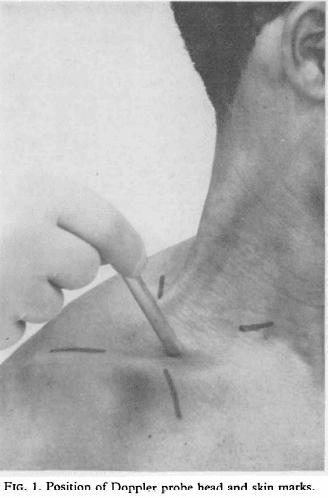
The first reported use of ultrasound was in 1978 by P. La Grange et al when they used Doppler ultrasound (Fig. 1) to localize the third part of subclavian artery and administered brachial plexus block by supraclavicular approach. In 1994, S. Kapral et al first time reported USG guided brachial plexus block after visualisation of the anatomy of plexus in supraclavicular region.
Until the start of second decade of this century, the use of USG has spread into other areas apart from regional anesthesia like – neuraxial and pain services, vascular access, point of care ultrasound (POCUS), airway assessment and of course trans-esophageal echocardiography.
Ultrasound is a high frequency sound with mechanical vibrations above 20 KHz. Human ear can detect sounds between 20 Hz t0 20 KHz. Frequencies below 20 Hz are called as infra sound and elephants can communicate with each other using this frequency. Bats & Dolphins can produce and hear ultrasound between 20 KHz to 100 KHz. Above 100 KHz, naturally occurring frequencies are not present. Medical devices using ultrasound have frequency range between 2 to 15 MegaHz (2000 KHz to 20,000 KHz). Then, how are these frequencies generated? The answer lies in Piezo-Electric effect.
Piezo-Electric effect:
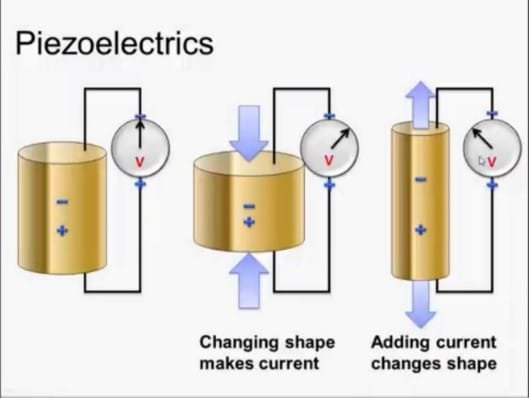
In 1880, French Physicists Pierre curie and Paul-Jacques Curie developed piezoelectric materials which could generate and receive mechanical vibrations. This material is made up of Lead Zirconate Titanate elements. Changing the shape of such elements produces current and conversely if current is applied to piezoelectric elements, they change shape (Fig 2). Individual Piezoelectric material produces small amount of energy. Stacking of such elements into layers in the transducer can convert electrical energy into mechanical oscillations & vice versa.
Speed of Ultrasound in tissues:
Ultrasound requires medium to travel and cannot pass through vacuum. The speed of ultrasound varies in different body tissues. The average speed in body tissues is 1540 meter/second. Bones and air are enemies of ultrasound as these waves cannot pass through these structures and this feature is used to our advantage during ultrasound scanning in regional anesthesia. Higher the frequency of ultrasound, lesser is the tissue depth penetration; but better is the quality/resolution of the image.
Nature of sound waves in tissues:
Sound wave is mechanical wave produced by the vibrating object and propagated through a medium
Sound wave is a pressure wave with repeating patterns of high and low pressure regions
Sound wave is a longitudinal wave where motion of particles is in parallel to direction of energy transport
Ultrasound, in the form of a pulsed beam, propagates from the surface of the transducer into soft tissue. Sound waves are absorbed in part by tissue but are also reflected back to the transducer where they are detected. As the depth increases, ultrasound waves get attenuated because of loss of amplitude and cannot get reflected back to the transducer. Increasing the amplitude at same frequency beyond the depth of attenuation helps in visualising the structures which were initially non visible. This process is called as Time Gain Compensation (TGC).
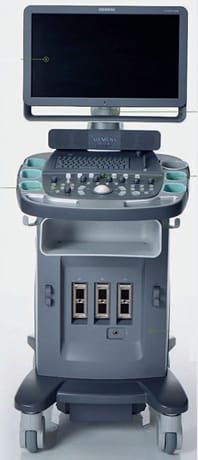
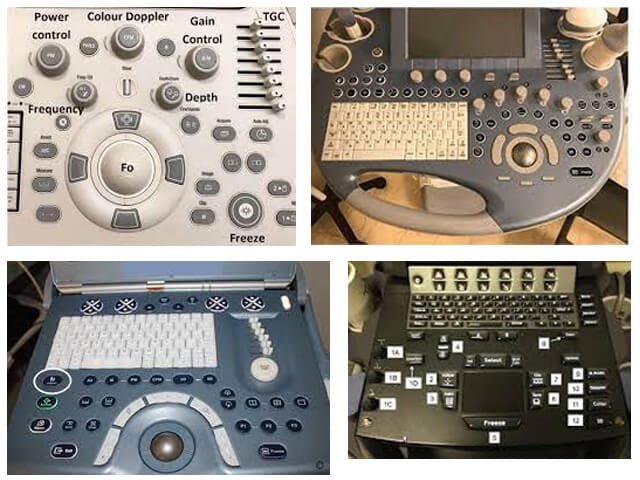
Components of Ultrasonography machine: (Fig 3 and 4)
Every USG machine constitutes three parts: 1) Monitor/Screen, 2) Console and 3) Probes
Console has power input, single or multiple probes attachment site and control panel.
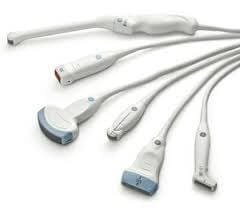
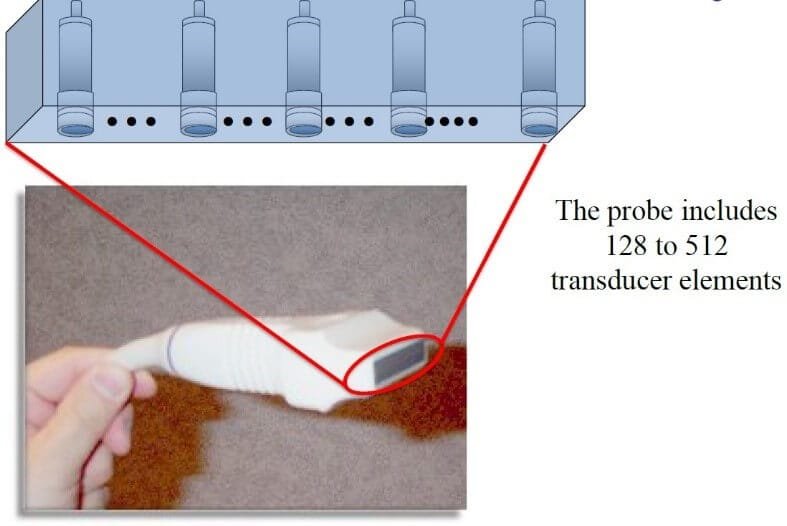
The control panel (Fig 5) of every USG machine can be different with similar or lesser or more functions. But the operator should be knowing the minimum required keys and control for regional anaesthesia conduction. In regional aesthesia practice, linear probe and curved probe are used. The probe includes 128 to 512 piezoelectric transducer elements (Fig 6). The probe acts as source of ultrasound waves as well as receiver of reflected waves.
Fig. 3
Fig 4
Fig 5Fig 6
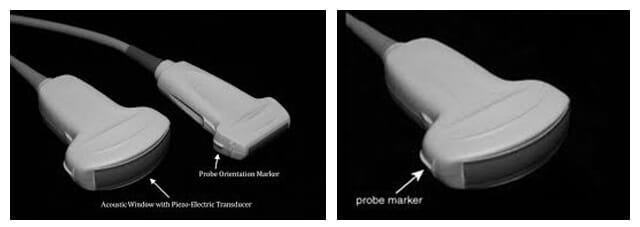
Linear probe (Fig 7) is a high frequency probe with frequency range between 5 to 12 MHz. The transducers of high frequency have thin piezoelectric elements that generate pulses of short wavelength. The depth of penetration with this probe is about 5 cm; so mainly used for visualising shallower structures. The image seen on the screen with linear probe has rectangular. High frequency probes give good resolution of image. Resolution is defined as the ability of the device to differentiate two closely situated objects as distinct structures.
Orientation Marker on the probe corresponds with the dot/marker on the screen.
Curved or curvilinear probe (Fig 8) is a low frequency probe with frequency range between 2 to 6 MHz. The transducer generates pulses of longer wavelength. The depth of penetration is high; so mainly used for visualising deeper structures. But the image resolution is low. The ultrasound waves are divergent with curved probe; so is the image on the screen which looks sectoral.
Fig 7 – Fig 8
Modes of Ultrasound:
A Mode: This is the oldest ultrasound technique which uses single piezoelectric element. The formed image is one dimensional. This mode is not used in regional anaesthesia
B Mode: This is the primary mode used in regional anaesthesia. The formed image of scanned area is two dimensional. There is linear array of 100 to 300 piezoelectric elements.
Doppler Mode: This is named after the Austrian Physicist, Johann Christian Doppler. The main use of this mode is to detect vascular flow. At stationary position, sound frequency is constant. Moving sound source causes change in frequency as well as wavelength with respect to sound receiver. This effect is called as Doppler shift. If sound source moves towards receiver, sound waves have to be squeezed and that results in high pitched sound called as Positive Doppler Shift. Conversely, if sound source moves away from the receiver, sound waves are stretched resulting in low pitched sound called as Negative Doppler Shift. Power Doppler mode is up to 5 times more sensitive in detecting small blood vessels. It does not provide information about direction of the flow. Colour Doppler is a colour coded map of Doppler shift superimposed on B Mode image. Red colour indicates flow towards the transducer while blue colour indicates flow away from transducer.
M Mode: (Motion mode) – It gives image with motion signal. Used in cardiology to study heart valves which are depicted in wave like manner. Not useful in regional anaesthesia.
Ultrasound Controls:
Though the USG machine has many switches on control panel, there are few ones which must be known while performing regional anaesthesia.
The list is as follows:
Power source
Probe selection
Depth selection
Gain – near/far
T.G.C.
Focus
Dynamic Range
Colour Doppler
Freeze
Advantages of Ultrasound in regional Anaesthesia:
Real time ability to visualise neural structures, needle tip advancement and local anaesthetic spread with decreased possibility of nerve damage due to intraneural nerve injection
Lesser volume/dose of Local anaesthetic requirement
Repeatability even after drug injection
Negligible chance of intravascular injection
Decreased pain from muscular contractions (as seen with PNS)
Decreased need for rescue analgesia
Anomalous anatomy can be known
Ultrasound interaction with the tissues:
Sound follows the principles of optics. When ultrasound waves traverse the body tissues, there are multiple interactions during the path like
Reflection – indicates echogenicity and accordingly gives the type of image..
Refraction
Scatter
Absorption
Refraction and scatter interactions do not have major impact. Heat is generated at the site of absorption. Though in clinical conditions, does not cause harm; but there is potential danger of thermal injury.
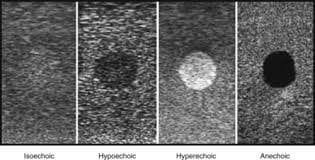
Ultrasound Images: (Fig 9)
Isoechoic: When the structure of interest has similar echogenicity or appearance as the surrounding tissue, it is called as isoechoic. The structure of interest looks same as surrounding tissue.
Hypoechoic: When the structure of interest has lesser echogenicity as the surrounding tissue, it is called as hypoechoic. The structure of interest is slightly darker than surrounding tissue.
Hyperechoic: When the structure of interest has more echogenicity as the surrounding tissue, it is called as hypoechoic. The structure of interest is slightly brighter/white than surrounding tissue. Ex. Bones, pleura
Anechoic: When the structure of interest has no echogenicity (nothing is reflected back) and it looks black, it is called as anechoic. Fluid filled structures like cysts or blood vessels are anechoic.
Fig 9
Artefacts during ultrasound imaging:
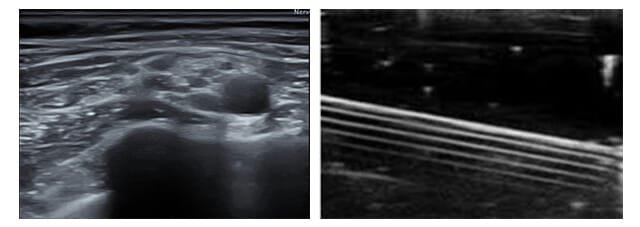
Shadowing: When ultrasound waves get totally reflected from tissue surface like bone, there is nothing visible beyond the hyperechoic line created by bone surface. This is called as shadowing (Fig 10).
Enhancement: When ultrasound waves traverse through anechoic structures like cyst or artery, some bright image is formed beyond the distal wall of cyst or artery. This is called as enhancement (Fig 10).
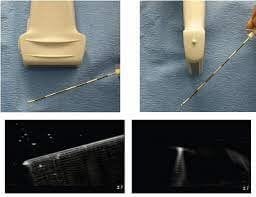
Reverberation: When highly reflective surface like needle is in the path of ultrasound waves, there occurs tow things. Firstly, waves falling directly on the needle get reflected causing hyperechoic shadow. Secondly, the waves coming back fro distal areas fall on other side of the needle repeatedly and give rise to multiple echogenic images which start fading distally. This is called reverberation (Fig 11).
Mirror Image: Exact mirror image is seen distally to highly reflective surface. But the resolution is less compared to original image.
Velocity Error: Due to different sound velocities in various tissues, the needle appears to be bent.
Fig 10 – Fig 11
Needling Techniques: (Fig 12)
In Plane or Long Axis: Needle Shaft is parallel to ultrasound beam and complete needle seen. Needle Tip is visualised as a step. Easier to learn
Out of Plane or Short Axis: Needle shaft is perpendicular to the ultrasound beam. Complete needle is not seen. The needle part is seen as dot. The visualised part may not always be the tip of the needle.
Fig 12
How to get good ultrasound image?
Know the anatomy
Select correct Probe
Jelly to prevent air interface between probe and skin
If I remember correctly, it was 2010, when I started my freelance anaesthesia practice in periphery of Nagpur. That time, I was very much passionate about about only two things- hard work and movies. A movie “ZOOTHA HI SAHI”, was released, starring John Abraham and Pakhi Tyrewala. Though a flop venture, I was attracted by its story line. John connected to Pakhi through an accidental phone call as a suicidal help line. He offered her a soothing ear to share her pain…. develop an understanding emotional relationship… followed by love. The whole movie was shot on American background. What I admire most , the handsome John plus, and American culture of systemicity, and support groups– a gathering of unrelated people connected through common pain, problems or diseases, providing emotional, support to each other.
I am an Indian, a hardcore one. But sometimes I want to deny it, seeing hopelessness, scenario in above context.
In movie , Pakhi got a masculine, handsome, caring hand on verge of suicide. I dreamed of myself in her place. 😊😊😊- — my fantasies, you know!🥰🥰.
In next few years, my time took a sharp , bitter turn. In midst of prolonged burn out, tired of repeated unending rejections from all sides, cursing life, one day I decided to gave up. Though exhausted emotionally, but as a last measure ( (fantasizing the movie), to get help I called Nagpur 24×7 suicidal helpline. Eagerly waiting for a soft sympathetic response. After a killing silence and long ring a lady picked up phone and ask, in a rough and impatient tone “KAUN BOL RAHA HAI??”.Amused by her roughness and throat filled with swallowed tears, I took few more seconds to answer. Before I could barely utter a word, lady on other side responded “ABHI HAMARA LUNCH TIME HAI, EK GHANTE BAAD PHONE KARNA”. And she hung up.
For next sometime, I felt stunned! Followed by burst of tears mixed with laughter. 😭😭😭🤣🤣🤣🤣😭😭😭🤣🤣🤣🤣. And rest is the history.
I woke up from slumber😴 And apprehended life isn’t just a number! I woke up to a harsh reality That time is not a cheap entity I looked into the mirror, 🪞 And stared at my image in horror😱 Oh is it me? Where did the glow ✨dissipate The lines on my face had a tale to narrate Each one depicted the experience, I couldn’t even recollect🤔 The deep line on the forehead made me frown🤨 The exact expression had brought them down! Someone advised me not to worry too much Your face gives everything away! Not being concerned? Is it possible in any which way? My roving eye 👀 set on the hair Silver strands blew up in the air No matter how much I try to tuck them away Or colour them with black, blonde or burgundy The greys peep out from the temples This is just one of many examples I sometimes go weak in the knees A feeling quite diverse from the teens Oh! It’s just the symptom of the fifties Then one day I have a rendezvous with my pals Lovely time with dance, music and ball💃🏻 Everyone appeared same more or less Life was galloping 🐎at a rapid pace Receding hairlines, 👴🏼paunch and yet deeds so tall Enjoyed the camaraderie one and all Such is the law of nature Every fruit 🍎 must mature All the worries I let go Now is the time to enjoy and slow Live each moment until it’s time to go Reap the fruits that you sow As you mature, you get respect and are revered Must bask in the glory of your hard work Relish and revel in each day remember After all age is just a number!
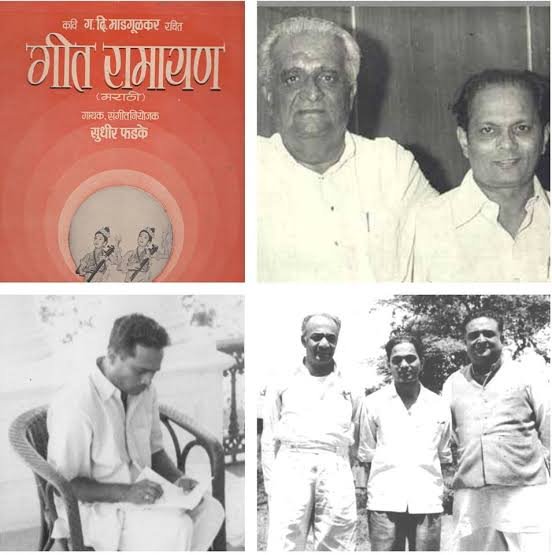
बाबूजी उपाख्य सुधीर फडके- मराठी गीत-संगीतसृष्टीस पडलेले एक गोड स्वप्न! गेल्या तीन पिढ्यांपासून मराठी भावविश्व समृद्ध व नादमधूर करणार्या बाबूजींच्या व्रतस्थ व ध्येयासक्त जीवनाचा नवीन पिढीस परिचय व्हावा, एतदर्थ ही लेखमाला!
‘पराधीन आहे जगती पुत्र मानवाचा’
बाबूजींच्याच एका गाण्याच्या शब्दांत थोडासा फरक करुन त्यांच्या चरणी मागणे मागतो…
तिन्हीं लोक आनंदाने, भरुन जावू दे! तुझे गीत गाण्यासाठी शब्द लाभू दे! पौर्णिमा शब्दांची माझ्या तूला वाहू दे! चांदण्यात आनंदाच्या मला न्हावू दे!
आजकालच्या गल्लाभरु चित्रपटांवर वाढणार्या आणि त्या चित्रपटांतील नट-नट्यांचे जीवन म्हणजेच ‘हिरो’चे जीवन समजणार्या आजच्या पिढीला चित्रपटसृष्टीत राहूनही कुणी असे उच्च नैतिक,राष्ट्रभक्तीयुक्त व व्रतस्थ जीवन जगू शकतो,हे ऐकून आश्चर्य वाटेल. नितीमूल्यांवर निष्ठा असेल, संस्कारांचे बाळकडू असतील अन् मनात राष्ट्रभक्तीची ज्योत प्रज्ज्वलित असेल तर परिस्थिती कितीही बिकट असो अन् क्षेत्र कुठलेही असो, जीवनात एक उच्च, उदात्त, उन्नत आदर्श निर्माण करता येतो; याचे बाबूजींचे आयुष्य म्हणजे चालतेबोलते उदाहरण.
२५ जुलै १९१९ ला जन्मलेल्या बाबूजींचे शैशव कोल्हापूरात गेले. त्यांचे खरे नांव रामचंद्र विनायक फडके. कोकणातील मूळ वाडाफणसे या गावचे हे फडके कुटुंब. पूढे कधीतरी कोल्हापूरात येवून वसले. गीतकार व संगीतकार म्हणून नावारुपास येण्यापूर्वी मात्र बाबूजींना दुर्दैवाचे अक्षरशः दशावतार पहावे लागले.
दैव ज्यात दुःखे भरता दोष ना कुणाचा, पराधीन आहे जगती पुत्र मानवाचा
या गीतरामायणातील त्यांच्याच गीतातील शब्दांना सार्थ ठरवणारे सुख-दुःखांच्या लाटांवर सतत हेलकावे खाणारे असे त्यांचे आयुष्य राहिले.लहानपणीच आई देवाघरी गेली. वडील तसे पेशाने वकील. पण पत्नीच्या निधनाने त्यांनी हाय खाल्ली आणि त्यांचे व्यवसायातील लक्षच उडाले. मग कुटुंबाच्या भाळी आले अठराविश्वे दारिद्र्य. थोरल्या भावाला शुगर-मिलमध्ये तुटपुंज्या पगाराची नोकरी धरावी लागली. स्वतः संगीत शिक्षण घेत असलेल्या बाबूजींनी पंडितराव ठाणेकर यांच्या ‘श्रीकृष्ण हार्मोनियम क्लास’मध्ये शिकवणी घेणे सुरु केले. दरम्यान कोल्हापूर, पूणे, मुंबई आदि गावांमधून ‘पोटासाठी दाही दिशा,अम्हां फिरविसी जगदीशा’ झाले.कुठेही काही थार मिळेना. परंतु या दुर्दैवाच्या व दारिद्र्याच्या काळातही बाबूजींची ध्येय, तत्व व मूल्यांवरची निष्ठा, वागण्यातले मार्दव आणि संगीतावरील भक्ती अणूमात्रही कमी झाले नाही. त्यांच्याच आणखी एका गीतातील शब्दांत त्यांचे वर्णन करता येईल,
विमोह त्यागूनि कर्मफलांचा सिद्ध होई पार्था! कर्तव्याने घडतो माणूस,जाणून पुरुषार्था.
दारिद्र्याचे चटके खात बाबूजींची वाटचाल सुरु होती. अनेकदा आशेचा किरण दिसायचा, नवीन वाटचाल सुरु व्हायची पण नियती असं काही फासे फेकायची की पुनः सारे शून्यवत् होवून जाई.१९३०-३१ सालची गोष्ट असेल. अब्दुल करीम खाँसाहेबांसमोर गाण्याची स्पर्धा होती. यात लहानग्या रामने मूलतानी रागातील एक चीज गावून दाखवली व प्रथम पारितोषिक पटकावले. यानंतर कोलम्बिया म्युझिक कंपनीने त्यांची ध्वनिफित (ऑडिओ कॅसेट) काढायचे ठरवले. मात्र ‘यशाची हवा या मुलाच्या डोक्यात जाईल’ असा विचार करुन त्यांचे गुरु- बाबूराव गोखले यांनी परस्पर नकार कळविला. अन्यथा कदाचित त्याचवेळी एक नवीन कुमारगंधर्व महाराष्ट्राला मिळाला असता. पण नियतीपूढे ‘पराधीन आहे जगती पुत्र मानवाचा‘ हेच खरे.
पुढील पाच-सहा वर्षे परिस्थितीशी झगडतांना रामला वडिलांचा मृत्यूही पचवावा लागला आणि कोल्हापूर सोडावे लागले. १९३७ मध्ये जमखंडीच्या मामाचा निरोप आला कि दस्तुरखुद्द अब्दुल करीम खाँसाहेबांनी रामला शिकायला बोलावले आहे. परंतु राम निघण्यापूर्वी पाच-सहा दिवसांतच वर्तमानपत्रात बातमी आली-‘दौर्यावर असतांनाचा खाँसाहेबांचा हृदयविकाराने मृत्यू झाला.’ झाले….पुन्हा पहिले पाढे पंचावन्न.
कधी बहर,कधी शिशिर परंतु दोन्ही एक बहाणे डोळ्यांमधले आसू पुसती ओठांवरले गाणे
अशी त्यांच्याच गीतात वर्णिल्याप्रमाणे त्यांची अवस्था झाली. १९३७-३८ च्या काळात ते मुंबईला आपल्या रायकर या मित्राच्या घरी आश्रिताप्रमाणे राहिले. पण मानी मनाला ते पटेना. तेही घर सोडले. कधी भाजी वीक, कधी चहा वीक असे करता करता आपली वाद्येही त्यांना वीकावी लागली. शेवटी मुंबई सोडून नाशिकला आले. परंतु कुणीही त्यांचं गाणं केलं नाही. खिश्यात केवळ अकरा आणे. अशा वेळी त्यांच्या एका संघ स्वयंसेवक मित्राने मालेगावच्या एका काळे नामक व्यक्तीचा संदर्भ दिला. काळेंनी मालेगावात सुधीर फडकेंचा जाहीर कार्यक्रम केला. चक्क पाच रुपये बिदागीही मिळाली. आपल्या ‘जगाच्या पाठीवर’ या आत्मचरित्रात बाबूजी लिहीतात, “त्या दिवशी तो कार्यक्रम झाला नसता, तर मी भूकेने मरुन गेलो असतो, गुन्हेगार झालो असतो नाहीतर चक्क आत्महत्या केली असती.”
ईथून मात्र बाबूजींच्या आयुष्याच्या एका नवीन पर्वाचा प्रारंभ झाला.
“उघड दार देवा आता”
बाबूजींच्या गाण्याचा जाहीर कार्यक्रम मालेगावात झाला आणि त्यांच्या आयुष्यातील एक नवीन पर्व सुरु झाले. मालेगाव, धूळे, धरणगाव, इंदोर, देवास, बिलासपूर, कानपूर, आग्रा आदि अनेक शहरांत बाबूजींना कार्यक्रमासाठी आमंत्रणे येवू लागलीत. कोलकाताच्या ‘इंडिया रेकाॅर्डिंग कंपनी’तून त्यांना ध्वनिमुद्रिकेच्या रेकाॅर्डिंगचे आमंत्रणही आले. रसिकांचे उदंड प्रेम सगळीकडून त्यांना मिळत होते. आता आपण कोलकात्यात स्थिरावू असे त्यांना वाटत असतानाच पुनः नियतीने कूस बदलली. लहानपणी त्यांना सांभाळणार्या दादाची तब्येत अतिशय खराब असल्याचे त्यांना कळले व ते कोल्हापूरास निघाले. काही दिवसांनी दादाची तब्येत तर सुधारली पण बाबूजी स्वतःच आजारी पडले. आजारपणात दीड महिना निघून गेला आणि दरम्यान कोलकात्याहून निरोपही आला की रेकाॅर्डिंग संपली असून बाबूजींची तिथे आता काही गरज नाही. पुन्हा पहिले पाढे पंचावन्न. कोल्हापूराहून उज्ज्वल भविष्याच्या आशेने निघालेले बाबूजी पुन्हा कोल्हापूरातच पोहोचले आणि आता पूढे काय, हा प्रश्न आवासून उभा होता. बाबूजी देवाची आणि दैवाची जणू कळवळून करुणा भाकत होते-
‘उघड दार देवा आता!उघड दार देवा!!’
आणि देवाने व दैवाने दरवाजा उघडला. कोल्हापूरात त्यांना काही मित्र मिळाले.आणि यातीलच एक मित्र असा मिळाला ज्याच्यासोबत मिळून बाबूजींनी मराठी भावमनावर चिरकाळ साम्राज्य गाजविणारा ‘गीत-रामायण’ रुपी इतिहास रचला. हा मित्र होता ग.दि. माडगूळकर उपाख्य गदिमा.
कोल्हापूरच्या या मित्रांनी गदिमांचे शब्द व बाबूजींचे संगीत व गायन असणारी रॅकाॅर्ड काढली व बाबूजींची पहिली रेकाॅर्ड तयार झाली.यादरम्यान आणखी एक आनंदाची गोष्ट घडली. कोल्हापूरात त्यावर्षी आचार्य अत्र्यांच्या अध्यक्षतेखाली अ.भा.मराठी साहित्य संमेलन होते.त्या साहित्य संमेलनात बाबूजींसाठी गायनाचे निमंत्रण त्यांच्या एका मित्राने मिळवले. गदिमांचीच एक कविता बाबूजींनी गाऊन दाखवली.त्याला अनेक ‘वन्स मोअर’ मिळाले आणि साहित्य संमेलन असल्यामुळे बाबूजींचे व गदिमांचे नाव रातोरात चोहीकडे गाजले.
त्यानंतर ‘गदिमा व बाबूजी’ या जोडगोळीने असंख्य चित्रपटगीतांचे दान मराठी रसिकांच्या पदरात घालून महाराष्ट्राच्या अनेक पिढ्यांचे भावविश्व समृद्ध व मधूर केले.१९४६ साली संगीतबद्ध केलेला ‘गोकुळ’ हा बाबूजींच्या कारकिर्दीतला पहिला चित्रपट. मराठीसह अनेक हिंदी चित्रपटगीतांनादेखील बाबूजींनी संगित दिले.’भाभी की चूडिया’ मधील ‘ज्योती कलश झलके’ किंवा किशोरदांच्या आवाजातील ‘खूश हैं जमाना,आज पहिली तारीख हैं’ ही गीते बाबूजींनीच संगितबद्ध केलेली. पण त्यानंतर मराठी गानसृष्टीच बाबूजींनी अधिक जवळ केली.सुमारे १११ चित्रपटांना त्यांनी संगित दिले. चित्रपटगीतांखेरीज अनेक भावगीतेही बाबूजींनी गायलीत. ‘तोच चंद्रमा नभांत’, ‘धुंदी कळ्यांना,धुंदी फुलांना’, ‘चंद्र आहे साक्षीला’, ‘तुझे गीत गाण्यासाठी’, ‘देहाची तिजोरी’, ‘सखी मंद झाल्या तारका’, ‘एकवार पंखावरुनि फिरो तुझा हात’ यांसारख्या असंख्य गीतांच्या अमृतवर्षावाने आजही मराठी कान तृप्त होताहेत व मराठी माणूस चांदण्यात न्हावून निघतोय. जवळजवळ पन्नास वर्षे मराठी गीत-संगीतसृष्टीचे ते अनभिषिक्त सम्राट होते.
दरम्यान सहगायिका ललिता देऊळकर यांच्यासोबत बाबूजी रेशीमबंधात अडकले.त्यांच्या विवाहातील मंगलाष्टके साक्षात महम्मद रफींनी गायली होती.काय दृष्य असेल ते.
‘स्वयें श्री बाबूजी ऐकती, रफी साहेब मंगलाष्टके गाती.
यानंतर १९५५-५६ यावर्षी आकाशवाणीवर छप्पन आठवडे ‘गीत-रामायण’ रुपी जो इतिहास घडतांना महाराष्ट्राने अनुभवला,त्याबद्दल पुढे…
“गीतरामायण-ज्योतीने तेजाची आरती”
श्रीराम-उभ्या राष्ट्राचे आराध्यदैवत! युगानुयुगांपासून आमच्या भारतीय मूल्यांचा,आदर्शांचा आणि जीवन जगण्याच्या एकूणच तत्वज्ञानाचा मूलाधार!! संपूर्ण भरतवर्षाला एकतेच्या सूत्रात गुंफणारा धागा!!! आणि आमचा धर्म, आमची संस्कृती अन् भारतीय म्हणून जगतात आमची जी ओळख आहे, त्याचे अधिष्ठान असणारा आमचा प्रातःस्मरणीय राष्ट्रपुरुष!!!
राम, राष्ट्र आणि स्वातंत्र्यवीर विनायक दामोदर सावरकर ही बाबूजींचीही तीन दैवतं. या तीनही दैवतांची बाबूजींनी स्वकर्मकुसुमे अर्पून आजन्म, आमरण,आजीवन अर्चना केली. या व पुढील भागात त्यांच्या रामभक्ती, सावरकरभक्ती व राष्ट्रभक्तीचेच गान मी गाणार आहे.
दि.1 एप्रिल 1955.रामनवमी. आकाशवाणीवरुन गीतरामायणाचे ध्वनीक्षेपण सुरु झाले. सुमारे वर्षभर छप्पन आठवडे हे ध्वनीक्षेपण चालले. अन् त्याने महाराष्ट्रात ‘न भूतो न भविष्यती’ असा इतिहास घडविला. तसे तर रामकथेचे प्रत्येक भारतीयाने बालपणापासूनच श्रवण केलेले असते. परंतू गीतरामायणातील आपल्या ओघवत्या, प्रासादिक शब्दांनी गदिमांनी आणि आपल्या तितक्याच मधूर, दैवी आवाज व रसाळ व भावमधूर चालींनी बाबूजींनी अख्ख्या महाराष्ट्राला रामरंगी रंगवून टाकले. कमीत कमी वाद्ये व वादकांमध्ये अप्रतिम चाली बांधणं, यात बाबूजींचा हातखंडा होता. गीतरामायण सुरु झाले की लोक रेडीओपूढे उदबत्ती लावून; गंध,फूले, अक्षता वाहून भक्तीभावाने बसत, असं जुन्या पिढीतील लोक सांगतात. गीतरामायण हे गदिमा व बाबूजी या दोघांच्याही आयुष्यातील एक अक्षय असे ऐश्वर्यपर्व आहे. कवी व गायक या दोघांनाही बावनकशी रामभक्ती व नवनवोन्मेषशालिनी प्रतिभा लाभलेली असल्यामुळे गीतरामायणाच्या निमित्ताने त्यांची झालेली युती म्हणजे जणू मणिकांचन योगच.
गदिमांची गीते चांगली कि बाबूजींच्या चाली व आवाज चांगला असा पेच श्रोत्यांना पडून ‘येथ अलंकरले कवण कवणे, हे निर्वचेना’ अशी त्यांची अवस्था होवून जाते. सुरुवातीला सारी गाणी बाबूजींनीच गायलीत. त्यानंतर काही गाणी त्यांनी माणिक वर्मा, पं.वसंतराव देशपांडे, ललिता देऊळकर-फडके यांच्याकडून गाऊन घेतलीत तर काही त्यांनी स्वतः गायलीत. शब्द कसे उच्चारावेत, त्यातही ‘श’,’ष’,’क्ष’ हे शब्द कसे उच्चारावेत आणि गाण्यातून भावना कशा व्यक्त कराव्यात, याचा बाबूजी हे एक वस्तूपाठच होते. ‘स्वयें श्रीरामप्रभू ऐकती’ या गीतातील सुरुवातीचेच ‘श्रीराम….श्रीराम’ किंवा ‘प्रत्यक्ष’ हे शब्द ऐकतांना याची प्रचिती येते.
बाबूजींनी भारतभर व विदेशांत मिळून गीतरामायणाचे सुमारे 1800 कार्यक्रम केले. या कार्यक्रमांच्या वेळी सारे वातावरणच राममय होवून जाई. लक्ष्मणाकडून नाक कापले गेल्यानंतर रावणाच्या दरबारात शूर्पणखेने घातलेल्या गोंधळाचे सूड घे त्याचा लंकापती हे गीत बाबूजी इतक्या त्वेषाने म्हणत की त्या गाण्यानंतर त्यांना अक्षरशः धापा लागत व त्या गाण्यावर पाणी पिण्यासाठी अंतराळ म्हणून कार्यक्रमाचा मध्यांतर होई. ‘जय गंगे,जय भागिरथी! जय जय राम दाशरथि!!’ या गाण्याच्या वेळी श्रोते आपणच जणू प्रत्यक्ष श्रीरामचंद्रांना बोटीत बसवून नेतोय अशा भावनेने हातात हात गुंफून डोलत आणि ‘सेतू बांधा रे!सेतू बांधा रे सागरी’ या गाण्यांच्या वेळी लोक अक्षरशः जागेवर नाचत.
दोन ओंडक्यांची होते सागरात भेट एक लाट तोडी त्यांना,पुन्हा नाही गाठ क्षणिक तेवी आहे बाळा मेळ माणसांचा पराधीन आहे जगती पुत्र माणसाचा
हे गाणं ऐकून रडला नाही, असा कुणी आजवर कुणाला सापडला कां हो ? आजही गीतरामायणाच्या कार्यक्रमांना मिळणारा उदंड प्रतिसाद ही या दोघांच्या ऐतिहासिक कामगिरीची व त्यांनी मराठी भावमनावर केलेल्या उपकाराची एक पावतीच आहे. ही गाणी इतकी गाजलीत की पूढे आसामी, बंगाली, हिंदी, इंग्रजी, कोंकणी, सिंधी, तेलुगू, ओडीया आणि कानडी या नऊ भाषांमध्येही त्यांची भाषांतरे झालीत. आधीच रामचरित्र गोड, त्यात गदिमांची रसाळ शब्दरचना, त्याला बाबूजींनी बांधलेल्या लाघवी चाली आणि त्यांनीच दिलेला दैवी, कर्णमधूर सूर. मग या शब्द-स्वर-सूरत्रयीची माधुरी काय वर्णावी! बाबूजींच्या एका गाण्यात म्हटल्याप्रमाणे जणू
तुझा शब्द की थेंब हा अमृताचा तुझा सूर की भास हा चांदण्याचा
अशीच अनुभूती श्रोत्यांना व्हायची. वाल्मिकी,कम्ब,तुलसीदासांच्या रांगेत स्थान देवून गदिमांना महाराष्ट्राने ‘आधुनिक वाल्मिकी’ ही पदवी देवून गौरविले.अन् अयोध्यावासीयांनी ज्याप्रमाणे कुश-लवांना कानांचे प्राण करुन ऐकले व गौरवले तद्वत उभ्या महाराष्ट्राने बाबूजींना डोक्यावर घेतले.गदिमांचे काव्य म्हणजे जणू ‘स्वयें श्रीरामप्रभू ऐकती’ या गीतात म्हटल्याप्रमाणे प्रत्यक्षाहून प्रतिमा उत्कट आहे; तर या रामाने त्या रामाची गायलेली आरती म्हणजे ज्योतीने तेजाची आरती च आहे.(बाबूजींचे खरे नांव राम फडके).बाबूजी गातांना प्रत्यक्ष रामचंद्रही जणू उपस्थित राहत असावेत,इतकी ती स्वर्गीय अनुभूती असे. म्हणूनच म्हणावेसे वाटते-
स्वातंत्र्यवीर विनायक दामोदर सावरकर, राम व राष्ट्र ही बाबूजींची तीन दैवते.मागील भागात रामभक्तीचे गायन झाले.आज त्यांच्या राष्ट्र व सावरकरभक्तीचे गान गाऊन माझ्या लेखणीला विराम देतो.
बाबूजी हे चित्रपटसृष्टीसारख्या दिखावू, झगमगाटी अन् बाह्यावडंबरी क्षेत्रात राहूनही अत्यंत साधे, नितीसंपन्न, ध्येयासक्त अन् व्रतस्थ असे तपस्वी जीवन जगू शकले याला कारण म्हणजे त्यांच्या अंतरीची राष्ट्रभक्ती आणि त्यांच्यावरील सावरकरी संस्कार.त्यांचे वडील निस्सीम सावरकरभक्त.त्यामुळे घरातच ‘राष्ट्रीय संस्कारांचे’ बाळकडू मिळाले.त्यातच लहानपणापासून संघशाखेवर जाणे सुरु झाले.संघातील विशुद्ध राष्ट्रभक्तीचे संस्कार, जाती-पातींच्या वर उठून सारा भारतीय समाज माझा आहे,ही समरसतेची शिकवण आणि आपला इतिहास,संस्कृती व आपले राष्ट्रपुरुष यांच्याबद्दलचा जाज्वल्ल्य पण सार्थ अभिमान सहजच त्यांच्याही अंगी उतरला. केवळ संस्कारांच्या गप्पा नाहीत तर आपल्या जीवनाचा अधिकाधिक वेळ प्रत्यक्ष राष्ट्रकार्यासाठी देणार्या अनेक संघप्रचारकांचा व गृहस्थ कार्यकर्त्यांचा जवळून सहवास लाभल्याने ‘परिसाच्या संगे लोह बि घडले,लोह बि घडले ते सुवर्णचि झाले.’ अनेक संघसमर्पित जीवनांच्या परिसस्पर्शाने बाबूजींचीही देशभक्ती केवळ बोलघेवडी न राहता प्रत्यक्ष कृतीशील झाली.बाबूजी आपल्या अत्यंत हालाखीच्या व धडपडीच्या काळात काही काळ धूळे जिल्ह्यातील शहाद्याला संघप्रचारक राहिलेत.
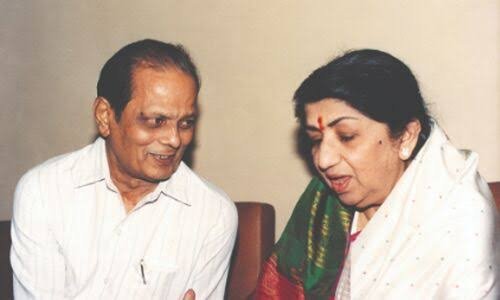
गोवा-दमण-दीव मुक्तीचा लढा हे तर बाबूजींच्या राष्ट्रजीवनातील एक सोनेरी पानच म्हणायला हवे. पोर्तुगीजांच्या सालाझारी राजवटीविरुद्ध ‘आझाद गोमांतक दला’ने आंदोलन उभारले होते. बाबूजी, शिवशाहीर बाबासाहेब पुरंदरे आदि संघाच्या अन्य हजारो स्वयंसेवकांनी यात उडी घेवून ‘संयुक्त मुक्ती आघाडी’ स्थापन केली. बाबूजींनी गानकोकिळा अन् स्वतः गोमंतककन्या असणार्या लता मंगेशकरांनाही यात आणले. २ मे १९५४ ला पुण्यातील हिराबागेत लतादीदींनी गोवा मुक्ती आंदोलनातील क्रांतीकारकांसाठी शस्रास्त्रे खरेदी करण्यासाठी निधी संकलित करता यावा यास्तव एक ‘संगीत-रजनी’ केली. १ऑगस्ट १९५४ च्या रात्री ‘आझाद गोमांतक दल’ व रा. स्व. संघाच्या कार्यकर्त्यांनी सिल्व्हास्यात प्रवेश केला अन् मुक्तीलढ्यास एक निर्णायक रुप दिले. अखेर भारत सरकारने सैन्य पाठवून गोवा-दमण-दीवला १९ डिसेंबर १९६१ रोजी पोर्तुगीजांच्या तावडीतून मुक्त केले आणि देशाला खर्या अर्थाने परदास्याच्या श्रुंखलांतून संपूर्णपणे मुक्त केले. गोवा मुक्ती आंदोलनातील स्वातंत्र्यसैनिक मोहन रानडे व डाॅ. मॅस्करहॅन्स हे लिस्बनच्या तुरुंगात खितपत पडले होते. या स्वातंत्र्यवीरांच्या सुटकेसाठीही बाबूजींनी विश्वव्यापक आटापीटा केला.
बाबूजींच्या संवेदना केवळ सप्तसूरांपुरती किंवा काव्याशयापुरती मर्यादित नव्हत्या तर सभोवतीच्या समाजाचे कण्हणेही त्यांना ऐकू येई. सामाजिक समरसता ते प्रत्यक्ष जगत. स्वातंत्र्यानंतरही एका दलित स्त्रीची विवस्त्र धिंड काढल्याचे ऐकून अत्यंत व्यथित अंतःकरणाने त्यांनी मुंबईच्या हुतात्मा चौकात उपोषण केले होते.
श्रीरामजन्मभूमी मुक्तीलढ्याच्या वेळी तर बाबूजींनी वयाची सत्तरी ओलांडली होती. परंतु एखाद्या तरुणाला लाजवेल अशा उमेदीने व उत्साहाने त्यांनी प्रत्यक्ष कारसेवेसाठी लढ्यात उडी घेतली. या वयात तो साहजिकच केवळ धार्मिक भावनेचा उन्माद नव्हता. रामजन्मभूमी मुक्तीलढा हा बाबूजींसाठी फक्त हजारो ओसाड देवालयांपैकी एकाचे राजकीय लाभासाठी चालवलेले आंदोलन नव्हते, तर ते आपल्या राष्ट्रीय अस्मितेच्या व अभिमानाच्या प्रतिकाच्या पुनःप्रस्थापनेचे रणशिंग होते. शेकडो वर्षांच्या गुलामगिरीचा राष्ट्रीय मनावर उमटलेला जो ओरखडा होता, तो पुसून टाकून पुनश्च एकवार सत्वसंपन्न, स्वत्वसंपन्न व स्वाभिमानसंपन्न राष्ट्राच्या पुनर्निमितीची ती रणभेरी होती. बाबूजींच्या मते हा हिंदू-मुस्लिम असा लढा तर नव्हताच नव्हता. कारण बाबर वा राममंदिर ध्वंस करणारा मीर बाकी या परकीय आक्रमकांशी भारतीय हिंदूंचे जितके काहीच नाते नाही, तितकेच ते भारतीय मुस्लिंमाचेही नाहीच नाही. राम हाच प्रत्येक भारतीय हिंदूचा राष्ट्रपुरुष व प्रत्येक भारतीय मुस्लिमाचाही ‘ईमाम-ए-हिंद’ आहे, ही त्यांची दृढभावना होती.
बाबूजींच्या राष्ट्रप्रेमाचा कळसाध्याय म्हणजे ‘वीर सावरकर’ या चित्रपटाची निर्मिती. आपल्या यश-किर्ती, पुरस्कार आदिंनी भौतिकदृष्ट्या परिपूर्ण अशा जीवनातील शेवटच्या वर्षांमध्ये फक्त हा चित्रपट निर्मिणे हेच त्यांच्या जीवनाचे एकमेव साध्य उरले होते. खरे पाहता तेही एक साधनच होते. वीर विनायकाच्या उर्जस्वल व तेजःपुंज जीवनयज्ञापासून प्रेरणा घेवून नवा सशक्त, समर्थ व संपन्न भारत घडविण्याचे साधन. या चित्रपटासाठी त्यांनी अविश्रांत मेहनत घेतली. हा चित्रपट लोकाश्रय व लोकसहभागातूनच पूर्ण व्हावा, हे त्यांचे स्वप्न होते. समविचाराच्या कार्यकर्त्यांची फळी तयार करणे, जगाच्या कानाकोपर्यातून निधी गोळा करणे, त्यासाठी दौरे, बैठकी व सांस्कृतिक कार्यक्रम करणे, पटकथा व दिग्दर्शनासाठी योग्य लेखक व दिग्दर्शक शोधणे, तंत्रज्ञ व कलाकारांची जुळवाजुळव करणे, अशा अनेक कामांची दगदग बहात्तर वर्षांचा हा ‘तरुण’ झपाटल्यागत करु लागला. खरंतर ‘गीतरामायणा’ चे कार्यक्रम करणे त्यांनी कधीच बंद केले होते. परंतु निधी उभारण्यासाठी पुन्हा सलग पाच पाच दिवस चार-चार तासांचे कार्यक्रम त्यांनी केलेत. शब्दशः रक्ताचे पाणी करुन बाबूजींनी हे ‘वीर सावरकर’ चे स्वप्न पूर्ण केले. स्वा.सावरकरांनी आपल्या ‘सागरा प्राण तळमळला’ मध्ये म्हटल्याप्रमाणे बाबूजींनी
गुणसुमने मी वेचियली या भावे कि तिने सुगंधा घ्यावे. जरि उद्धरणी व्यय न तिच्या हो साचा हा व्यर्थ भार विद्येचा
या भावनेनी आपली सूर, स्वर, गायकी, चित्रपटनिर्मिती आदि सार्या गुणांची सुमने फक्त त्या ‘विनायका’ च्या चरणी अर्पण केलीत व अभ्युदयासोबत निःश्रेयसाची अर्थात भौतिक यशासोबत आध्यात्मिक समाधानाची प्राप्ती करुन एका परिपूर्ण व कृतकृत्य जीवनाची अनुभूती घेतली. म्हणूनच बाबूजींच्या राष्ट्रभक्तीला त्यांच्या सप्तस्वरांनी आधीच समृद्ध असलेल्या जीवनातला ‘आठवा स्वर’ म्हणावेसे वाटते.
प. पू. श्री गोळवलकर गुरुजींचे यथार्थ वर्णन असणारे ‘चाहिये आशीष माधव’ हे गीत बाबूजींनी गायले आहे. खरे तर त्यातील वर्णन बाबूजींनाही चपखल बसते. त्याच गीतातील दोन कडव्यांनी या लेखमालेची सांगता करतो.
शत्रू को भी जितता था आपका चारित्र्य उज्वल निंदकों पर मात करता आपका व्यवहार निर्मल। मातृभू की वेदना जो आपके ऊर में बसी थीं पा सके अल्पांश भी तो पूर्ण होंगी साधना।।
देवइंगित पर तुम्हारे ध्येयपथ पर बढ रहें हैं आपसे ज्योतित अनेकों दीप अविचल जल रहें हैं। राष्ट्रजीवन का गहन तम शीघ्र ही मिटकर रहेंगा मातृमंदिर में विभूषित दिव्य तव आराधना।।
🇮🇳 ।।भारत माता की जय।। 🇮🇳
By Dr. Sachin Jambhorkar Consultant Anaesthesiologist & Pain Specialist, National Cancer Institute, Nagpur.
Hysteroscopy involves visualization of uterine cavity for diagnostic or therapeutic purposes.
Diagnostic procedures are required :-
To find the cause of abnormal uterine bleeding and obtain a biopsy
To investigate cause of primary or secondary infertility
In recurrent miscarriages
Therapeutic procedures are :-
Removal of submucous fibroids
Removal of polyps
Resection of intrauterine septum
Targeted biopsy
Adhesiolysis of intrauterine synechiae
Hysteroscopic procedures require distension of the uterine cavity. The most common distending media that have been used are :-
Carbon dioxide gas
Glycine, Mannitol or sorbitol that are hypotonic
Normal Saline, which is isotonic
Carbon dioxide is no longer used as distension medium as vision is obscured due to bleeding during the procedure. Hence fluid media are preferred. The equipment used for distension is called hysteromat or endomat. The maximum pressure should be 70-100 mm Hg or pressure just adequate to visualize uterine cavity. Resection of the endometrium or fibroids requires use of large diameter hysteroscopes with continuous flow of irrigating medium. They involve a working element with electrically active loop using monopolar current with non-electrolyte distending media like glycine or sorbitol. However, these solutions are hypotonic and utmost vigilance is required to prevent excessive absorption, which may cause life-threatening hyponatremia. Isotonic electrolyte containing fluids like normal saline cannot be used with monopolar energy as it leads to activation of ions and dispersal of electric current and hence reduce power density, which may be ineffective to destroy the tissue. Newer resectoscopes have been developed to use bipolar current and they are compatible with electrolyte containing distension media such as ringer lactate or normal saline. These solutions have reduced the incidence of hyponatremia considerably.
Anesthesia for Hysteroscopic procedures
Regional anesthesia either spinal or epidural is preferred over general anesthesia for early recognition of symptoms of fluid overload.
Short procedures like diagnostic hysteroscopy can be done under total intravenous anesthesia (TIVA).
General anesthesia is given if the patient is anxious or if laparoscopy may be done along with hysteroscopy where either laryngeal mask airway or endotracheal tube is inserted. Hysteroscopy may also be performed as an office procedure using miniature (1.9 mm) hysteroscope. Oral administration of NSAIDs should be done to reduce pain during procedure, opiates are not recommended. Intracervical and paracervical infiltration of local anesthetic can be done to alleviate vasovagal response during the procedure.
Complications of Hysteroscopy are
Fluid overload or TURP like syndrome
Air embolism
Uterine perforation
Fluid overload
Fluid deficit is defined as difference between the volume of irrigating fluid that goes inside the uterine cavity and that flushes out of the uterine cavity during the procedure.
Fluid deficit of 1000 ml results in fluid overload while using hypotonic solution like glycine. Fluid deficit of 2500 ml while using isotonic solution like normal saline may cause fluid overload in a healthy woman of reproductive age group. However, for women with cardiorespiratory compromise or renal impairment, threshold should be reduced to 750 ml for hypotonic solution and 1500 ml for isotonic solution.
Absorption of distension medium from open sinuses of the uterine cavity can cause fluid overload. It can occur with both isotonic and hypotonic solutions; however, incidence is higher with hypotonic solutions.
Factors, which lead to fluid, overload are :-
High intrauterine distension pressure, duration of procedure, depth of myometrial penetration, size of myoma and volume of medium used.
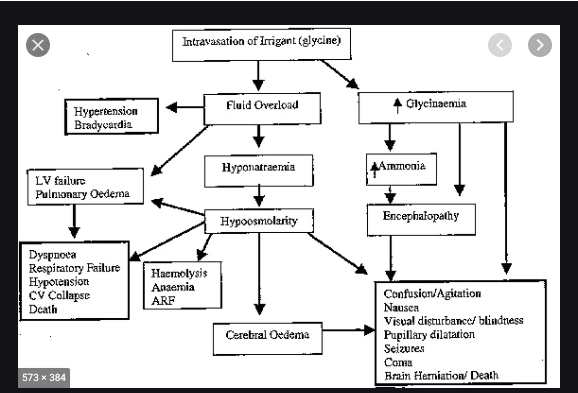
Signs and symptoms of fluid overload are due to hyponatremia, which is common with glycine or any hypotonic medium. Patient will have
Nausea, vomiting
Confusion, disorientation
Focal weakness, convulsions
Pulmonary edema and cardiac failure
Coma, respiratory arrest, brainstem herniation, death
Input and output should be meticulously calculated using calibrated drapes and reservoirs and must be assessed at every 10-minute interval. A closed loop system should be employed for exact estimation of input and output of the distension medium. A decrease in serum sodium of 10mmol/L corresponds to 1000 ml of fluid absorbed if the solution is 1.5% glycine.
Intravasation of Irrigant (glycine)
Management of suspected hypervolaemic hyponatraemia due to fluid overload
Moderate fluid overload causes hypervolaemia and dilutional hyponatraemia. If serum Na+ concentration falls below 120 mmol/L, symptoms develop. Patient complains of headache, nausea, vomiting, weakness. If intravasation continues, water moves into intracellular and interstitial space leading to brain edema and rise in intracranial pressure. Patient may have symptoms like agitation, confusion, nausea, vomiting, headache and visual disturbances. If continued can lead to brain stem herniation, coma and death.
Asymptomatic hyponatraemia can be treated with fluid restriction and frusemide.
Symptomatic hyponatraemia requires multidisciplinary approach and high dependency care. 100ml bolus of 3% saline over 10 min to be repeated 3 times followed by IV infusion of 3% hypertonic saline 1-2 mmol/L/h is indicated. The target is to increase serum sodium 6 mmol/L over 24 hours until 130 mmol/L is achieved. Rapid correction of hyponatremia may cause pontine myelinolysis or osmotic demyelination syndrome. After recovery from hyponatremai, a biphasic reaction occurs and patient suffers from swallowing difficulty, gait changes and other neurological symptoms.
Acute hypervolamic hyponatraemia
Management
Asymptomatic hyponatraemia (Na+ >120 mm0l/L
Fluid restriction<1L/day and 40 mg frusemide
Symptomatic hypoosmolar (Na+ <120 mmol/L
Hypertonic saline (3%) (1L=513 mmol, Normal saline 1L =154mmol) Supplemental oxygen, indwelling urinary catheter, high dependency unit, multidisciplinary involvement
Normal sodium levels are between 135-145 mmol/L
Air or gas embolism during hysteroscopy
Air or gas embolism is rare but can occur during hysteroscopic procedure. Air can enter the uterine cavity if the tube is not primed with fluid or appearance of bubbles in the solution. If the patient develops sudden desaturation, air embolism should be suspected.
Tips and tricks to reduce fluid absorption
Use of GnRh agonist before resection of myoma, which can reduce the volume of fibroid
Intracervical injection of dilute vasopressin reduces absorption of fluid.
3. Intrauterine pressure should be kept below mean arterial pressure. A pressure between 70-100 mm Hg is considered safe.
Use of automated fluid administering systems which maintain a constant pressure and accurate calculation of fluid deficit.
References:-
2013 AAGL Practice Report: practical Guidelines for the Management of hysteroscopic distension media. J Minim Invasive Gynecol 20:137–148.
Propst A, Liberman RF, Harlow BL, Ginsburg ES (2000) Complications of hysteroscopic surgery: predicting patients at risk. Obstet Gynecol 96:517–520
Aydeniz B, Gruber IV, Schauf B, Kurek R, Meyer A, Wallwiener D (2002) A multicenter survey of complications associated with 21676 operative hysteroscopies. Eur J Obstet Gynecol Reprod Biol 104:160–164
aschopoulos M, Polyzos NP, Lavasidis LG, Vrekoussis T, Dalkalitsis N, Paraskevaidis E (2006) Safety issues of hysteroscop- ic surgery. Ann N Y Acad Sci 1092:229–234
Varol N, Maher P, Vancaillie T, Cooper M, Carter J, Kwok A, Reid G (2002) A literature review and update on the prevention and management of fluid overload in endometrial resection and hyster- oscopic surgery. Gynaecol Endosc 11(1):19–26
Cooper NAM, Smith P, Khan KS, Clark TJ.Analgesia and conscious sedation for pain control during outpatient hysteroscopy: a systematic review and meta-analysis; 2009. Personal communication.
Cicinelli E, Didonna T,Ambrosi G, Schönauer LM, Fiore G, Matteo MG.Topical anaesthesia for diagnostic hysteroscopy and endometrial biopsy in postmenopausal women: a randomised placebo-controlled double-blind study. Br J Obstet Gynaecol 1997; 104:316–9.
Lau WC,Tam WH, Lo WK,Yuen PM.A randomized double- blind placebo-controlled trial of transcervical intrauterine local anaesthesia in outpatient hysteroscopy. BJOG 2000; 107:610–3.
It was a lazy Sunday morning and I was sipping my cup of happiness and staring at the blue canopy that was covering my terrace. I was lost in the morning freshness watching the bird’s fly! It seemed that the green mango tree with its lanceolate leaves was beckoning me. And the foliage surrounding the parapet felt like a green ornament adorned by the blue sky.
“What is your ikigai mom? “My trail of thoughts was interrupted by a familiar voice. “Wha… ” I exclaimed,” what is my what?” The word was new to me, though I had heard about it, but was unsure about the meaning. “Your ikigai ” my daughter repeated, “your purpose in life?” “Oh, I never thought about it”, I said.
Living the life of a doctor and that too an anesthesiologist was not easy. You were constantly on your toes and giving anesthesia to your patients and bringing them back safely was the only thing I had been doing over the years. Though this pandemic had given me some spare time to reflect upon my life.
“Here read this, it is an international super seller.” She showed me a book titled, ‘IKIGAI‘ the Japanese secret to a long and healthy life! The book was intriguing and as I went through the chapters it enraptured me. Ikigai is hidden deep inside each one of us, the book read. The simple life of people in Okinawa, a Japanese island where most centenarians lived, fascinated me.
We keep living a double life, captured in our own routine and forget about our ikigai; which is the reason we get up in the morning. We need to search for it. The question kept coming to my mind.
What is your passion in life?
What is your mission?
What is the reason for your being?
The purpose of your life is so important in Japan that the idea of retirement simply does not exist. The sense of purpose plays an important role in their health and longevity.
So, the most important things for a long life are not just diet, exercise and a healthy lifestyle. But also, your ikigai, your circle of friends and the security of your family. So now the question is how to find your ikigai? The answer to your question, “What makes you feel the happiest?” is your ikigai! So, find it. Your existential purpose in life!
The most down moments of my life are when I have nothing to do or look forward to, I reflected. My constant creativity keeps me going, I pondered. So, to keep me going in life, I need my dessert of creativity, as the food of routine work is not enough for me!
One thing I loved about the Japanese philosophy is that they believe in teamwork and the feeling of brotherhood. The negativity of jealousy about others only pulls you down bringing down your own productivity. I believe in the maxim that you should be your own competitor. Excel for a better tomorrow and reflect upon your life. See whether your today is better than yesterday.
Hara Hachi Bo!! It is a Japanese fitness mantra, which means, eat only till you are 80% full. Eat less to live longer. So that extra dessert on your plate is not necessary. Variety is the key to a healthy diet and so serve a rainbow on your plate.
Your mind is a powerful tool for your journey towards longevity. Focus on the positive things in life, practice yoga and meditation. The mind dictates your body. So, a healthy mind is needed for a healthy body. Logotherapy is helping people discover themselves. They don’t create the meaning of life. They discover it.
I loved the example given for logotherapy; about a grief-stricken elderly doctor who had lost his wife and had come to Viktor Frankl, for the treatment of depression. Frankl asked the doctor a question. What if you had died before your wife? The doctor was horrified even thinking about it. And without a word left Frankel’s office, finding peace with his present situation. So, it is about the way you think that can bring you peace.
Stress is accused of killing longevity. A lot of stress is responsible for premature aging. Stress was good for the flight or fight response. But the constant flow of cortisol in the body is responsible for health problems and chronic fatigue syndrome.
However, some amount of stress is good for you. A study conducted by Dr. Howard Friedman, a psychology professor at the University of California, Riverside, showed that those who faced challenges and worked hard to succeed, lived longer.
Sitting is the new smoking. Sedentary lifestyle can lead to hypertension, cardiovascular disease and even cancer. So, walk for 20 minutes per day, participate in social activities, join a sport or dance. Make small changes in your routine to stay fit. Sleep is very important and it strengthens the immune system. The pandemic has taught us the importance of immunity. Be happy and sing your heart out. It is good for your lungs. Don’t worry if you are not good at it.
Stay active and don’t retire. Keep doing your bit. Our fingers are connected to our brain so use them creatively. Those who stop doing what they love, loose purpose in life. Surround yourself with friends and positive people.
Reconnect with nature. Gardening is another stress buster and gives you peace. It recharges you. Live every moment of life as if it were your last; and follow your Ikigai!!
So, here’s wishing you a happy and purposeful life!
By Dr. Kiran Vyawahare Consultant Anaesthesia & Pain medicine.
Covid19 pandemic has challenged us to unforeseen levels and greatly disrupted our routine daily life. But crisis created by the pandemic has also yielded some valuable lessons.
Here are some to consider….
1] Family matters the most….
Before the pandemic many of us have taken human interaction for granted. The idea of complete lock-down and no connection with outside world would have seemed silly a while ago. Nobody in their wildest of dreams would have imagined such a weird situation………. but then everything changed.
The frustration of daily confinement made us realize that Family matters the most.
The moral support and strength we gain from our near and dear one works wonder on our mental well-being. That innocent smile on your little one’s face and a reassuring glance from your elders is enough to fill your heart with immense joy.
2] Hobbies are healing …..
Hobbies from singing and playing any instrument to gardening to cooking to painting have helped us to recharge ourselves. Our renewed enthusiasm towards a forgotten hobby made us remember old friends and feel nostalgic. Planting a sapling with our kids or baking a bread with your partner strengthened mutual bonds. Pursuing a hobby gives you unmatched joy and relaxation and is the best way to detox and distress.
3} Essential workers are the real heroes….
During pre-COVID times we hardly noticed the significant role played by everyday helpers in our day to day life. The maid efficiently doing household chores of cooking, cleaning and washing, the silent garbage collector, the newspaper vendor, milk delivery boy etc. It was only during lock-down period we could realize and appreciate how important all these workers are and how much laborious their task is!!!
It’s long overdue that they are finally receiving the recognition they deserve. Showing gratitude for these everyday heroes will go a long way towards building lasting goodwill.
4] Health is Wealth …..
This age old proverb has made a strong comeback. When it comes to our health and wellness there is power in prevention. My mother in law had a very bad COVID but in spite of that she could come out of it stronger. Thanks to her daily routine of morning walk, yoga and Vipassana for last so many years that has built her immunity and inner strength. What we eat, our exercise habits. Sleep pattern and general hygiene awareness are the cornerstones of good health which eventually play very important role in building up immunity and face any unforeseen health issues.
5] Kids are the strongest …..
We as parents are so protective about our children. Always trying to protect them from harsh realities of life. With no school and friends around to play with, we all were so worried about how our kids would react to these challenging times. But to everyone’s surprise kids came out stronger and patient than expected. They quickly adjusted and moulded themselves to the new norms of online world.
6] Inner Beauty is Eternal …..
We spend so much time and energy on how we look and present ourselves to the outside world; but COVID has shown us the real mirror. In these challenging times when people were afraid of even a touch this inner beauty of pure and kind heart has urged us to help mankind. This selfless service shown by humans towards others has saved so many lives and fed so many hungry bellies around the globe. Joy of giving and sharing is long lasting and provides inner peace.
7] Slow down a bit …..
While COVID has prompted new found worries, it also forced us to slow down and evaluate how we cope with minimum essential. Staying at home and relying on less has taught us to re-examine our priorities. Buying every possible modern convenience is not necessary for our happiness. Leading a stressful life just to maintain the so called status in the society is definitely not essential for our survival.
Contented mind is the happiest!!!
Dr. Rashmi Shingade Consultant Anaesthesiologist Director Children Orthopaedic Care Institute
A general FAQ by random acquaintance, projecting dearth of adequate information and markedly lower level of understanding, sent a cringe on my face, being an avid admirer of the branch, “ANAESTHESIOLOGY”, a recognized speciality of field of Medicine.
The speciality which has witnessed ebb and flow of diversities and variations since its advent, in every nook and cranny, was seemingly destined to flourish from a barely diminutive existence to the staggering galactic stature. An ancient era of scientific revolution was strategically characterized by remarkable inventions and evolution in the field of Medicine. The advent of Surgery demanded need of Anaesthesia with an intention of enduring immense physical pain, perhaps one less thing to worry about, allowing surgical handiwork and ability to focus properly without the ‘distracting screams’. The mesmerizing golden past has been a testimony to the strife, discord and struggle of the field of Anaesthesia; from primitive “ Thump over the head with hammer” to the sophisticated gadgets to knock down the patient; from raw “Jadi-Buti” extracts to the modernised drugs; from sniffers to recent inhalational agents; from “Open drop” to techno-sound workstations ; many more instances to quote.
On 16th October, 1846, when first successful public demonstration of Ether Anaesthesia was accomplished, the milestone event was looked upon as freedom from agony, pain and misery. It opened gates to Pandora box which paved the path towards advancements not only in technique but also in technology and methodology. The questions unanswered so far, are that; Was it, the actual birth of Anaesthesia? When was the Anaesthesia given for the first time on this planet? Was Anaesthesia, a nonexistent entity before? Let’s take the help of mythology and tickle the minds a bit, to find out the answers . So, When was the first surgery done? Lord Shiva ordered head transplant of Lord Ganesha and the divine procedure was done uneventfully. Off-course, an unlabeled, undescribed and unclear method of anaesthesia must have been administered. Coming to stone age, the pictorial evidences of horrific forms of knocking down the patient during some surgical procedures are available. For instance, a procedure of right leg trauma was accomplished by striking on left leg with a heavy bamboo stick so as to divulge the victim from pain of surgical site. The anaesthesia techniques are too complex to be described in such a crude way. The speciality is neither too raw , nor a naïve invention, rather an eternal science, though an unpolished, rough-hewn culture hustling through anonymity, since medieval times. It is not merely about abolishing the screams, for sure. The intrigued mechanisms of algesia, conscience and bio-equilibrium are amicably required to formulate the techniques and methods. The tremendous research, scientific progress and prolific up-gradation has led the subject to giant escalation. In last one and half century, the subject achieved utmost refinement and phenomenally processed from rudimentary element to the astronomically gigantic prominence.
The present anaesthesiologist is a thorough clinician with wide spectrum of expertise, command and proficiency. The modern anaesthesiologist is physician par excellence, rendering services, not only in surgical areas , but also, out of confines beyond four walls of operation theater viz. Casualty, trauma center, emergency medicine, critical care, pain medicine, radiology suites, off-site locations , rehabilitation, hospice and palliative care, disaster management , etc., with comprehensive Covid care , a recently added arena. With the gloom of pandemic, the anaesthesiologists have emerged as dynamic intensivists, critical care physicians , disaster team leaders, administrators, policy makers and controllers. The bio-technological development and creative medical engineering plays an immense role in building up sophisticated inventory and providing logistic support in comprehensive health care. In present era, the state of art gadgets and equipments are mainstay in health system. The progressive journey from natural resources to modern artificial intelligence is inclusive of growth and transcendence. If I label this as Rebirth of the field, it would be reasonably acceptable.
The life of anaesthesiologist bristles with challenging waxes and wanes customarily. The combating obstacles are endless. In today’s era, the anaesthesiologists are, not only, expected to serve the society judiciously but also should strive towards creating awareness about the branch with a goal directed approach intending to clear myths and facts, and to eradicate associated prejudices. The existence of our branch stumbles upon past experiences and advances towards “ SAFETY, QUALITY AND ACCLIVITY”
“I believe that more you know about the past, better you are prepared for the future”
– Theodore Roosevelt
The future, though uncertain, shall be bright and illuminating with continued research, amendments and expedition. The evidences of Nuclear Physics, Robotic science, Nano- technology and Molecular biology are emergent in Medical science. The day is not far when such revolutionary technology shall be adopted in routine anaesthesia practice. The evolutionary journey of anaesthesia branch from ‘BIRTH TO REBIRTH’ has been characteristically strategic, conquering breakthrough landmarks.
“The deeds in the present will redeem the past and thereby, change the future”
Paulo Coelho
The future aims and objectives towards achieving targets are a staunch task to attain. The ultimate goal is “The Ideal scenario”; in which none shall question the dignity, prowess and integrity of the field of Anasesthesia ; the branch shall blossom to the pinnacle of advancement ; and the universe shall be at the summit of awareness about the science.
“The past is your lesson, the present is your gift, the future is your motivation”